

psyclone.psyGen#
This module provides generic support for PSyclone’s PSy code optimisation and generation. The classes in this method need to be specialised for a particular API and implementation.
Classes#
PSyFactory: Creates a specific version of the PSy.PSy: Base class to help manage and generate PSy code for a singleInvokes: Manage the invoke calls.Invoke: Manage an individual invoke call.InvokeSchedule: Stores schedule information for an invocation call. Schedules can beHaloExchange: Generic Halo Exchange class which can be added to andKern: Base class representing a call to a sub-program unit from within theCodedKern: Class representing a call to a PSyclone Kernel with a user-providedInlinedKern: A class representing a kernel that is inlined.BuiltIn: Parent class for all built-ins (field operations for which the userArguments: Arguments abstract base class.DataAccess: A helper class to simplify the determination of dependencies due toArgument: Argument base class. Captures information on an argument that is passedKernelArgument: This class provides information about individual kernel-callTransInfo: This class provides information about, and access to, the availableTransformation: Abstract baseclass for a transformation. Uses the abc module so it
- class psyclone.psyGen.PSyFactory(api='', distributed_memory=None)[source]#
Creates a specific version of the PSy.
- Parameters:
api (str) – name of the PSyclone API (domain) for which to create a factory.
distributed_memory (bool) – whether or not the PSy object created will include support for distributed-memory parallelism.
- Raises:
TypeError – if the distributed_memory argument is not a bool.
Inheritance
- create(invoke_info)[source]#
Create the API-specific PSy instance.
- Parameters:
invoke_info (
psyclone.parse.algorithm.FileInfo) – information on the invoke()s found by parsing the Algorithm layer.- Returns:
an instance of the API-specific sub-class of PSy.
- Return type:
subclass of
psyclone.psyGen.PSy- Raises:
InternalError – if this factory is found to have an unsupported type (API).
- class psyclone.psyGen.PSy(invoke_info)[source]#
Base class to help manage and generate PSy code for a single algorithm file. Takes the invocation information output from the function
parse.algorithm.parse()as its input and stores this in a way suitable for optimisation and code generation.- Parameters:
invoke_info (
psyclone.parse.algorithm.FileInfo) – An object containing the required invocation information for code optimisation and generation. Produced by the functionparse.algorithm.parse().
Inheritance

- property container#
- Returns:
the container associated with this PSy object
- Return type:
- property gen: str#
Generate PSy-layer code associated with this PSy object.
Note that the necessary PSy-layer symbols are added to the temporary copy of the tree before code-generation is begun. Since this tree copy is discarded at the end of this routine, those symbols will still not be present in the original tree.
- Returns:
the generated Fortran source.
- property invokes#
- Returns:
the list of invokes.
- Return type:
psyclone.psyGen.Invokesor derived class
- property name#
- Returns:
the name of the PSy object.
- Return type:
str
- class psyclone.psyGen.Invokes(alg_calls, invoke_cls, psy)[source]#
Manage the invoke calls.
- Parameters:
alg_calls (list of
psyclone.parse.algorithm.InvokeCall) – a list of invoke metadata extracted by the parser.invoke_cls (subclass of
psyclone.psyGen.Invoke) – an api-specific Invoke class.psy (subclass of :py:class`psyclone.psyGen.PSy`) – the PSy instance containing this Invokes instance.
Inheritance

- get(invoke_name)[source]#
Gets the Invoke with the supplied name. If the name does not already begin with
invoke_then a new name with this prepended is included in the search if no exact match is found initially.- Parameters:
invoke_name (str) – the name of the Invoke to get (not case- sensitive).
- Returns:
the invoke with the specified name.
- Return type:
- Raises:
RuntimeError – if no Invoke with the supplied name (with or without
invoke_prepended) exists.
- property psy#
- Returns:
the PSy instance that contains this instance.
- Return type:
subclass of
psyclone.psyGen.PSy
- class psyclone.psyGen.Invoke(alg_invocation, idx, schedule_class, invokes)[source]#
Manage an individual invoke call.
- Parameters:
alg_invocation (
psyclone.parse.algorithm.InvokeCall) – metadata from the parsed code capturing information for this Invoke instance.idx (int) – position/index of this invoke call in the subroutine. If not None, this number is added to the name (“invoke_”).
schedule_class (
psyclone.psyGen.InvokeSchedule) – the schedule class to create for this invoke.invokes (
psyclone.psyGen.Invokes) – the Invokes instance that contains this Invoke instance.
Inheritance

- first_access(arg_name)[source]#
Returns the first argument with the specified name passed to a kernel in our schedule
- property invokes#
- Returns:
the Invokes instance that contains this instance.
- Return type:
:py:class`psyclone.psyGen.Invokes`
- setup_psy_layer_symbols()[source]#
Declare, initialise and deallocate all symbols required by the PSy-layer Invoke subroutine.
By default does nothing - PSyKAL DSLs can specialise this method.
Currently this is done at “lowering”, but we could move it to psy-layer creation time to have the symbols available in the transformation scripts.
- unique_declarations(argument_types, access=None, intrinsic_type=None)[source]#
Returns a list of all required declarations for the specified API argument types. If access is supplied (e.g. “write”) then only declarations with that access are returned. If an intrinsic type is supplied then only declarations with that intrinsic type are returned.
- Parameters:
argument_types (list of str) – the types of the kernel argument for the particular API.
access (
psyclone.core.access_type.AccessType) – optional AccessType that the declaration should have.intrinsic_type (str) – optional intrinsic type of argument data.
- Returns:
a list of all declared kernel arguments.
- Return type:
list of
psyclone.psyGen.KernelArgument- Raises:
InternalError – if at least one kernel argument type is not valid for the particular API.
InternalError – if an invalid access is specified.
InternalError – if an invalid intrinsic type is specified.
- unique_declns_by_intent(argument_types, intrinsic_type=None)[source]#
Returns a dictionary listing all required declarations for each type of intent (‘inout’, ‘out’ and ‘in’).
- Parameters:
argument_types (list of str) – the types of the kernel argument for the particular API for which the intent is required.
intrinsic_type (str) – optional intrinsic type of argument data.
- Returns:
dictionary containing ‘intent’ keys holding the kernel arguments as values for each type of intent.
- Return type:
dict of
psyclone.psyGen.KernelArgument- Raises:
InternalError – if at least one kernel argument type is not valid for the particular API.
InternalError – if an invalid intrinsic type is specified.
- class psyclone.psyGen.InvokeSchedule(symbol, KernFactory, BuiltInFactory, alg_calls=None, **kwargs)[source]#
Stores schedule information for an invocation call. Schedules can be optimised using transformations.
- Parameters:
symbol (
psyclone.psyir.symbols.RoutineSymbol) – RoutineSymbol representing the invoke.KernFactory (type) – class instance of the factory to use when creating Kernels. e.g.
psyclone.domain.lfric.LFRicKernCallFactory.BuiltInFactory (type) – class instance of the factory to use when creating built-ins. e.g.
psyclone.domain.lfric.lfric_builtins.LFRicBuiltInCallFactory.alg_calls (list of
psyclone.parse.algorithm.KernelCall) – list of Kernel calls in the schedule.kwargs (unwrapped dict.) – additional keyword arguments provided to the super class.
Inheritance

- class psyclone.psyGen.HaloExchange(field, check_dirty=True, vector_index=None, parent=None)[source]#
Generic Halo Exchange class which can be added to and manipulated in, a schedule.
- Parameters:
field (
psyclone.lfric.LFRicKernelArgument) – the field that this halo exchange will act oncheck_dirty (bool) – optional argument default True indicating whether this halo exchange should be subject to a run-time check for clean/dirty halos.
vector_index (int) – optional vector index (default None) to identify which index of a vector field this halo exchange is responsible for.
parent (
psyclone.psyir.nodes.Node) – optional parent (default None) of this object
Inheritance

- property args#
Return the list of arguments associated with this node. Override the base method and simply return our argument.
- property dag_name#
- Returns:
the name to use in a dag for this node.
- Return type:
str
- property field#
Return the field that the halo exchange acts on
- property halo_depth#
Return the depth of the halo exchange
- node_str(colour=True)[source]#
Returns the name of this node with (optional) control codes to generate coloured output in a terminal that supports it.
- Parameters:
colour (bool) – whether or not to include colour control codes.
- Returns:
description of this node, possibly coloured.
- Return type:
str
- property vector_index#
If the field is a vector then return the vector index associated with this halo exchange. Otherwise return None
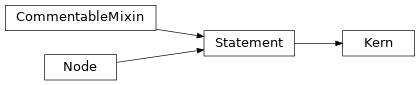
- class psyclone.psyGen.Kern(parent, call, name, ArgumentsClass, check=True)[source]#
Base class representing a call to a sub-program unit from within the PSy layer. It is possible for this unit to be in-lined within the PSy layer.
- Parameters:
parent (sub-class of
psyclone.psyir.nodes.Node) – parent of this node in the PSyIR.call (
psyclone.parse.algorithm.KernelCall) – information on the call itself, as obtained by parsing the Algorithm layer code.name (str) – the name of the routine being called.
ArgumentsClass (type of
psyclone.psyGen.Arguments) – class to create the object that holds all information on the kernel arguments, as extracted from kernel meta-data (and accessible here via call.ktype).check (bool) – whether to check for consistency between the kernel metadata and the algorithm layer. Defaults to True.
- Raises:
GenerationError – if any of the arguments to the call are duplicated.
Inheritance
- property args#
Return the list of arguments associated with this node. Override the base method and simply return our arguments.
- initialise_reduction_variable()[source]#
Generate PSyIR to zero the reduction variable and to zero the local reduction variable if one exists. The latter is used for reproducible reductions, if specified.
- Raises:
GenerationError – if the variable to initialise is not a scalar.
GenerationError – if the reprod_pad_size (read from the configuration file) is less than 1.
GenerationError – for a reduction into a scalar that is neither ‘real’ nor ‘integer’.
- Return type:
None
- is_coloured()[source]#
- Return type:
bool- Returns:
True if this kernel is being called from within a coloured loop.
- property is_reduction#
- Returns:
whether this kernel/built-in contains a reduction variable.
- Return type:
bool
- property name: str#
- Returns:
the name of the kernel.
- node_str(colour=True)[source]#
Returns the name of this node with (optional) control codes to generate coloured output in a terminal that supports it.
- Parameters:
colour (bool) – whether or not to include colour control codes.
- Returns:
description of this node, possibly coloured.
- Return type:
str
- property reduction_arg#
- Returns:
the reduction variable if this kernel/built-in contains one and None otherwise.
- Return type:
psyclone.psyGen.KernelArgumentor NoneType
- reduction_sum_loop(parent, position, table)[source]#
Generate the appropriate code to place after the end parallel region.
This method is designed to be used after a Kern has been lowered (and thus detached) and therefore does not use self.scope.
- Parameters:
parent (
Node) – the node to which to add the Loop as a child.position (
int) – where in the parent’s list of children to add the new Loop.table (
SymbolTable) – the SymbolTable to use.
- Raises:
GenerationError – for an unsupported reduction access in LFRicBuiltIn.
- Return type:
None
- property reprod_reduction#
- Returns:
whether this kernel/built-in is enclosed within an OpenMP do loop. If so report whether it has the reproducible flag set. Note, this also catches OMPParallelDo Directives but they have reprod set to False so it is OK.
- Return type:
bool
- class psyclone.psyGen.CodedKern(KernelArguments, call, parent=None, check=True)[source]#
Class representing a call to a PSyclone Kernel with a user-provided implementation. The kernel may or may not be in-lined.
- Parameters:
KernelArguments (type) – the API-specific sub-class of
psyclone.psyGen.Argumentsto create.call (
KernelCall) – Details of the call to this kernel in the Algorithm layer.parent (
Optional[Node]) – the parent of this Node (kernel call) in the Schedule.check (
Optional[bool]) – whether to check for consistency between the kernel metadata and the algorithm layer. Defaults to True.
Inheritance

- property ast#
Generate and return the fparser2 AST of the kernel source.
- Returns:
fparser2 AST of the Fortran file containing this kernel.
- Return type:
fparser.two.Fortran2003.Program
- property dag_name#
- Returns:
the name to use in the DAG for this node.
- Return type:
str
- get_callees()[source]#
Returns the PSyIR Schedule(s) representing the kernel code. The Schedules are just generated on first invocation, this allows us to retain transformations that may subsequently be applied to the Schedule(s).
- Returns:
Schedule(s) representing the kernel code.
- Return type:
- Raises:
NotImplementedError – must be overridden in sub-class.
- get_interface_symbol()[source]#
By default, a Kern is not polymorphic and therefore has no interface symbol.
- Return type:
None
- incremented_arg()[source]#
Returns the argument that has INC access.
- Return type:
str- Returns:
a Fortran argument name.
- Raises:
FieldNotFoundError – if none is found.
- lower_to_language_level()[source]#
In-place replacement of CodedKern concept into language level PSyIR constructs. The CodedKern is implemented as a Call to a routine with the appropriate arguments.
- Return type:
- Returns:
the lowered version of this node.
- property module_inline: bool#
- Returns:
whether or not this kernel is being module-inlined.
- property module_name#
- Returns:
The name of the Fortran module that contains this kernel
- Return type:
string
- node_str(colour=True)[source]#
Returns the name of this node with (optional) control codes to generate coloured output in a terminal that supports it.
- Parameters:
colour (
Optional[bool]) – whether or not to include colour control codes.- Return type:
str- Returns:
description of this node, possibly coloured.
- property opencl_options#
- Returns:
dictionary of OpenCL options regarding the kernel.
- Return type:
dictionary
- class psyclone.psyGen.InlinedKern(psyir_nodes, parent=None)[source]#
A class representing a kernel that is inlined. It has one child which stores the Schedule for the child nodes.
- Parameters:
psyir_nodes (list of
psyclone.psyir.nodes.Node) – the list of PSyIR nodes that represent the body of this kernel.parent (sub-class of
psyclone.psyir.nodes.Node) – the parent of this node in the PSyIR.
Inheritance

- class psyclone.psyGen.BuiltIn[source]#
Parent class for all built-ins (field operations for which the user does not have to provide an implementation).
Inheritance

- property dag_name#
- Returns:
the name to use in the DAG for this node.
- Return type:
str
- class psyclone.psyGen.Arguments(parent_call)[source]#
Arguments abstract base class.
- Parameters:
parent_call (sub-class of
psyclone.psyGen.Kern) – kernel call with which the arguments are associated.
Inheritance

- property acc_args#
- Returns:
the list of quantities that must be available on an OpenACC device before the associated kernel can be launched
- Return type:
list of str
- append(name, argument_type)[source]#
Abstract method to append KernelArguments to the Argument list.
- Parameters:
name (str) – name of the appended argument.
argument_type (str) – type of the appended argument.
- iteration_space_arg()[source]#
Returns an argument that can be iterated over, i.e. modified (has WRITE, READWRITE or INC access), but not the result of a reduction operation.
- Return type:
str- Returns:
a Fortran argument name
- Raises:
GenerationError – if none such argument is found.
- property names#
- Returns:
the Algorithm-visible kernel arguments in a comma-delimited string.
- Return type:
str
- abstractmethod psyir_expressions()[source]#
- Returns:
the PSyIR expressions representing this Argument list.
- Return type:
list of
psyclone.psyir.nodes.Node
- property scalars#
- Returns:
the list of scalar quantities belonging to this object
- Return type:
list of str
- class psyclone.psyGen.DataAccess(arg)[source]#
A helper class to simplify the determination of dependencies due to overlapping accesses to data associated with instances of the Argument class.
Inheritance

- property covered#
Returns True if all of the data associated with this argument has been covered by the arguments provided in update_coverage
- Return bool:
True if all of an argument is covered by previous accesses and False if not.
- overlaps(arg)[source]#
Determine whether the accesses to the provided argument overlap with the accesses of the source argument. Overlap means that the accesses share at least one memory location. For example, the arguments both access the 1st index of the same field.
We do not currently deal with accesses to a subset of an argument (unless it is a vector). This distinction will need to be added once loop splitting is supported.
- Parameters:
arg (
psyclone.psyGen.Argument) – the argument to compare with our internal argument- Return bool:
True if there are overlapping accesses between arguments (i.e. accesses share at least one memory location) and False if not.
- reset_coverage()[source]#
Reset internal state to allow re-use of the object for a different situation.
- update_coverage(arg)[source]#
Record any overlap between accesses to the supplied argument and the internal argument. Overlap means that the accesses to the two arguments share at least one memory location. If the overlap results in all of the accesses to the internal argument being covered (either directly or as a combination with previous arguments) then ensure that the covered() method returns True. Covered means that all memory accesses by the internal argument have at least one corresponding access by the supplied arguments.
- Parameters:
arg (
psyclone.psyGen.Argument) – the argument used to compare with our internal argument in order to update coverage information
- class psyclone.psyGen.Argument(call, arg_info, access)[source]#
Argument base class. Captures information on an argument that is passed to a Kernel from an Invoke.
- Parameters:
call (
psyclone.psyGen.Kern) – the kernel call that this argument is associated with.arg_info (
psyclone.parse.algorithm.Arg) – Information about this argument collected by the parser.access (str) – the way in which this argument is accessed in the ‘Kern’. Valid values are specified in the config object of the current API.
Inheritance

- property argument_type#
Returns the type of the argument. APIs that do not have this concept can use this base class version which just returns “field” in all cases. APIs with this concept can override this method.
- Returns:
the API type of the kernel argument.
- Return type:
str
- backward_dependence()[source]#
Returns the preceding argument that this argument has a direct dependence with, or None if there is not one. The argument may exist in a Call, a HaloExchange, or a GlobalReduction.
- Return type:
Optional[Argument]- Returns:
the first preceding argument that has a dependence on this argument.
- backward_write_dependencies(ignore_halos=False)[source]#
Returns a list of previous write arguments that this argument has dependencies with. The arguments may exist in a Call, a HaloExchange (unless ignore_halos is True), or a GlobalReduction. If none are found then return an empty list. If self is not a reader then return an empty list.
- Parameters:
ignore_halos (
bool) – if True then any write dependencies involving a halo exchange are ignored. Defaults to False.- Return type:
list[Argument]- Returns:
a list of arguments that have a preceding write dependence on this argument.
- property call#
Return the call that this argument is associated with
- property data_type#
- Returns:
the data type of this argument. Default value is None, explicit implementation is left to a specific API.
- Return type:
str or NoneType
- forward_dependence()[source]#
Returns the following argument that this argument has a direct dependence on, or None if there is not one. The argument may exist in a Call, a HaloExchange or a GlobalReduction.
- Return type:
Optional[Argument]- Returns:
the first following argument that has a dependence on this argument.
- forward_read_dependencies()[source]#
Returns a list of following read arguments that this argument has dependencies with. The arguments may exist in a Call, a HaloExchange or a GlobalReduction. If none are found then return an empty list. If self is not a writer then return an empty list.
- Return type:
list[Argument]- Returns:
a list of following arguments that have a read dependence on this argument.
- forward_write_dependencies(ignore_halos=False)[source]#
Returns a list of following write arguments that this argument has dependencies with. The arguments may exist in a Call, a HaloExchange (unless ignore_halos is True), or a GlobalReduction. If none are found then return an empty list. If self is not a reader then return an empty list.
- Parameters:
ignore_halos (
bool) – if True then any write dependencies involving a halo exchange are ignored. Defaults to False.- Return type:
list[Argument]- Returns:
the arguments that have a following write dependence on this argument.
- infer_datatype()[source]#
Infer the datatype of this argument using the API rules. If no specialisation of this method has been provided make the type UnresolvedType for now (it may be provided later in the execution).
- Returns:
the datatype of this argument.
- Return type:
:py:class::psyclone.psyir.symbols.DataType
- abstract property intrinsic_type#
Abstract property for the intrinsic type of the argument with specific implementations in different APIs.
- Returns:
the intrinsic type of this argument.
- Return type:
str
- property module_name#
- Returns:
the name of the Fortran module that contains definitions for the argument data type. Default value is None, explicit implementation is left to a specific API.
- Return type:
str or NoneType
- property precision#
- Returns:
the precision of this argument. Default value is None, explicit implementation is left to a specific API.
- Return type:
str or NoneType
- class psyclone.psyGen.KernelArgument(arg, arg_info, call)[source]#
This class provides information about individual kernel-call arguments as specified by the kernel argument metadata and the kernel invocation in the Algorithm layer.
- Parameters:
arg (
psyclone.parse.kernel.Descriptor) – information obtained from the metadata for this kernel argument.arg_info (
psyclone.parse.algorithm.Arg) – information on how this argument is specified in the Algorithm layer.call (
psyclone.psyGen.Kern) – the PSyIR kernel node to which this argument pertains.
Inheritance

- abstract property is_scalar#
- Returns:
whether this variable is a scalar variable or not.
- Return type:
bool
- property metadata_index#
- Returns:
the position of the corresponding argument descriptor in the kernel metadata.
- Return type:
int
- class psyclone.psyGen.TransInfo(module=None, base_class=None)[source]#
This class provides information about, and access to, the available transformations in this implementation of PSyclone. New transformations will be picked up automatically as long as they subclass the abstract Transformation class.
Warning
This utility will not find Transformations under the new file structure (TODO #620) and is deprecated.
Inheritance

- get_trans_name(name)[source]#
return the transformation with this name (use list() first to see available transformations)
- get_trans_num(number)[source]#
return the transformation with this number (use list() first to see available transformations)
- property list#
return a string with a human readable list of the available transformations
- property num_trans#
return the number of transformations available
- class psyclone.psyGen.Transformation[source]#
Abstract baseclass for a transformation. Uses the abc module so it can not be instantiated.
Inheritance
- abstractmethod apply(node, options=None, **kwargs)[source]#
Abstract method that applies the transformation. This function must be implemented by each transform. As a minimum each apply function must take a node to which the transform is applied, and a dictionary of additional options, which will also be passed on to the validate functions. This dictionary is used to provide optional parameters, and also to modify the behaviour of validation of transformations: for example, if the user knows that a transformation can correctly be applied in a specific case, but the more generic code validation would not allow this. Validation functions should check for a key in the options dictionary to disable certain tests. Those keys will be documented in each apply() and validate() function.
Note that some apply() functions might take a slightly different set of parameters.
- Parameters:
node (depends on actual transformation) – The node (or list of nodes) for the transformation - specific to the actual transform used.
options (Optional[Dict[str, Any]]) – a dictionary with options for transformations.
- get_option(option_name, **kwargs)[source]#
Finds the value of the option_name from the kwargs.
- Parameters:
option_name (
str) – The name of the option to find.- Return type:
Any- Returns:
the value of the option or the default if one is specified.
- Raises:
ValueError – if option_name is not found in the valid options for the Transformation.
- classmethod get_valid_options()[source]#
Pulls the valid options from the apply method. It also recurses upwards to the superclasses of this transformation and pulls their valid options as well if they exist.
- Return type:
Dict[str,ValidOption]- Returns:
A dict of the valid option name and corresponding ValidOption dataclass.
- property name#
- Returns:
the transformation’s class name.
- Return type:
str
- split_kwargs(**kwargs)[source]#
- Parameters:
kwargs – the list of kwargs to split.
- Return type:
tuple[dict[str,Any]]- Returns:
a tuple of the kwargs dictionaries that are valid for this transformation and every other transformation listed in the _SUB_TRANSFORMATIONS list. The first kwargs (the ones for itself) will also include any key that is not valid in any of the other transformation (this is done to ensure one of the validate_options reports invalid options when those are provided).
- validate(node, options=None, **kwargs)[source]#
Method that validates that the input data is correct. It will raise exceptions if the input data is incorrect. This function needs to be implemented by each transformation.
The validate function can be called by the user independent of the apply() function, but it will automatically be executed as part of an apply() call.
As minimum each validate function must take a node to which the transform is applied and a dictionary of additional options. This dictionary is used to provide optional parameters and also to modify the behaviour of validation: for example, if the user knows that a transformation can correctly be applied in a specific case but the more generic code validation would not allow this. Validation functions should check for particular keys in the options dict in order to disable certain tests. Those keys will be documented in each apply() and validate() function as ‘options[“option-name”]’.
Note that some validate functions might take a slightly different set of parameters.
- Parameters:
node (depends on actual transformation) – The node (or list of nodes) for the transformation - specific to the actual transform used.
options (Optional[Dict[str, Any]]) – a dictionary with options for transformations.