PSyIR Frontend and Backends#
Instead of creating PSyIR nodes manually, PSyclone provides PSyIR Frontends and PSyIR Back-ends to translate from/to other representations (such as languages like Fortran or C, or other Intermediate Representations like SIR).
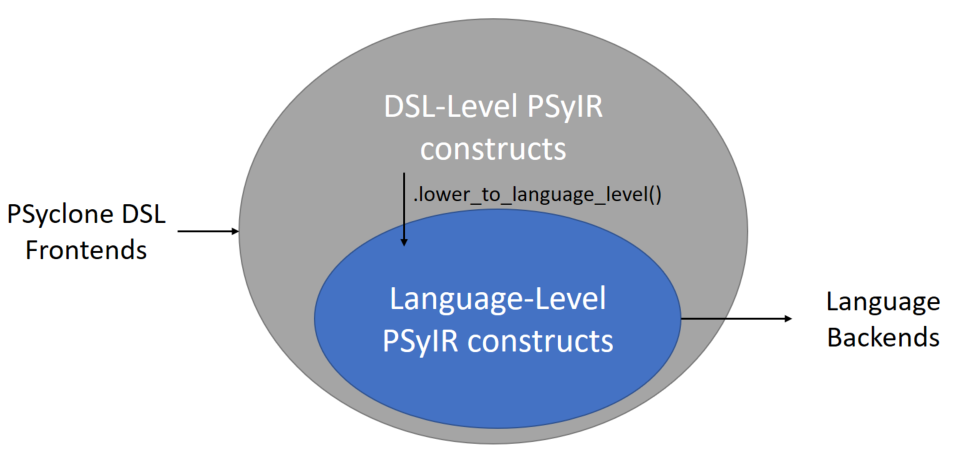
The set of PSyIR nodes that the frontends and backends recognise and translate to/from are known as the language_level nodes. PSyclone also provide Uplifting and lowering mechanism to support higher-level or domain-specific abstractions.
PSyIR Frontends#
Currently two Fortran frontends are available:
- fparser2:
This is the main Fortran frontend based on fparser2 and it is currently the only recommended stable option.
- treesitter:
This is a highly experimental frontend based on the treesitter parser which has the potential to be faster, but is currently severely incomplete and untested.
The frontend is selected with the psyclone --frontend <frontend> flag.
PSyIR Back-ends#
PSyIR back-ends translate PSyIR into another form (such as Fortran, C or
OpenCL) using a Visitor pattern approach.This approach separates the code to
traverse a tree from the tree being visited. The back-end visitor code
is stored in psyclone/psyir/backend.
Visitor Base code#
visitor.py in psyclone/psyir/backend provides a base class -
PSyIRVisitor - that implements the visitor pattern and is designed
to be subclassed by each back-end.
PSyIRVisitor is implemented in such a way that the PSyIR classes do
not need to be modified. This is achieved by translating the class
name of the object being visited in the PSyIR tree into the method
name that the visitor attempts to call (using the Python eval
function). _node is postfixed to the method name to avoid name
clashes with Python keywords.
For example, an instance of the Loop PSyIR class would result in
PSyIRVisitor attempting to call a loop_node method with the PSyIR
instance as an argument. Note the names are always translated to lower
case. Therefore, a particular back-end needs to subclass
PSyIRVisitor, provide a loop_node method (in this particular example)
and this method would then be called when the visitor finds an instance of
Loop. For example:
from psyclone.psyir.visitor import PSyIRVisitor
class TestVisitor(PSyIRVisitor):
    ''' Example implementation of a back-end visitor. '''

    def loop_node(self, node):
        ''' This method is called if the visitor finds a loop. '''
        print("Found a loop node")

test_visitor = TestVisitor()
test_visitor._visit(psyir_tree)
It is up to the sub-class to call any children of the particular node. This approach was chosen as it allows the sub-class to control when and how to call children. For example:
from psyclone.psyir.visitor import PSyIRVisitor
class TestVisitor(PSyIRVisitor):
    ''' Example implementation of a back-end visitor. '''

    def loop_node(self, node):
        ''' This method is called if the visitor finds a loop. '''
        print("Found a loop node")
        for child in node.children:
            self._visit(child)

test_visitor = TestVisitor()
test_visitor._visit(psyir_tree)
If a node is called that does not have an associated method defined
then PSyIRVisitor will raise a VisitorError exception. This
behaviour can be changed by setting the skip_nodes option to True
when initialising the visitor i.e.:
test_visitor = TestVisitor(skip_nodes=True)
Any unsupported nodes will then be ignored and their children will be called in the order that they appear in the tree.
PSyIR nodes might not be direct subclasses of Node. For example,
GOKernelSchedule subclasses KernelSchedule which subclasses
Routine which subclasses Schedule which subclasses Node. This can
cause a problem as a
back-end would need to have a different method for each class e.g. both
a gokernelschedule_node and a kernelschedule_node method, even if the
required behaviour is the same. Even worse, expecting someone to have
to implement a new method in all back-ends when they subclass a node
(if they don’t require the back-end output to change) is overly
restrictive.
To get round the above problem, if the attempt to call a method with
the name of the PSyIR class (with _node appended) fails, then the
PSyIRVisitor will subsequently call the method name of its parent
(with _node appended). This will continue with the PSyIRVisitor
working its way through the class hierarchy in method resolution order
until it is successful (or fails for all names and raises an
exception).
This implementation gives the behaviour one would expect from standard
inheritance rules. For example, if a kernelschedule_node method is
implemented in the back-end and a GOKernelSchedule is found then a
gokernelschedule_node method is first tried which fails, then a
kernelschedule_node method is called which succeeds. Therefore all
subclasses of KernelSchedule will call the kernelschedule_node
method (if their particular specialisation has not been added).
One example of the power of this approach makes use of the fact that
all PSyIR nodes have Node as a parent class. Therefore, some base
functionality can be added there and all nodes that do not have a
specific method implemented will call this. To see the
class hierarchy, the following code can be written:
class PrintHierarchy(PSyIRVisitor):
    ''' Example of a visitor that prints the PSyIR node hierarchy. '''

    def node_node(self, node):
    ''' This method is called if no specific methods have been
        written. '''
        print(f"[ {type(node).__name__} start]")
        for child in node.children:
            self._visit(child)
        print(f"[ {type(node).__name__} end]")

print_hierarchy = PrintHierarchy()
print_hierarchy._visit(psyir_tree)
In the examples presented up to now, the information from a back-end
has been printed. However, a back-end will generally not want to use
print statements. Output from a PSyIRVisitor is supported by
allowing each method call to return a string. Reimplementing the
previous example using strings would give the following:
class PrintHierarchy(PSyIRVisitor):
    ''' Example of a visitor that prints the PSyIR node hierarchy'''

    def node_node(self, node):
        ''' This method is called if the visitor finds a loop '''
        result = f"[ {type(node).__name__} start ]"
        for child in node.children:
            result += self._visit(child)
        result += f"[ {type(node).__name__} end ]"
        return result

print_hierarchy = PrintHierarchy()
result = print_hierarchy._visit(psyir_tree)
print(result)
As most back-ends are expected to indent their output based in some
way on the PSyIR node hierarchy, the PSyIRVisitor provides support
for this. The self._nindent variable contains the current
indentation as a string and the indentation can be increased by
increasing the value of the self._depth variable. The initial depth
defaults to 0 and the initial indentation defaults to two
spaces. These defaults can be changed when creating the back-end
instance. For example:
print_hierarchy = PrintHierarchy(initial_indent_depth=2,
                                 indent_string="***")
The PrintHierarchy example can be modified to support indenting by
writing the following:
class PrintHierarchy(PSyIRVisitor):
    ''' Example of a visitor that prints the PSyIR node hierarchy
    with indentation'''

    def node_node(self, node):
        ''' This method is called if the visitor finds a loop '''
        result = f"{self._nindent}[ {type(node).__name__} start ]\n"
    self._depth += 1
    for child in node.children:
        result += self._visit(child)
    self._depth -= 1
    result += f"{self._nindent}[ {type(node).__name__} end ]\n"
    return result

print_hierarchy = PrintHierarchy()
result = print_hierarchy._visit(psyir_tree)
print(result)
As a visitor instance always calls the _visit method, an alternative
(functor) implementation is provided via the __call__ method in the
base class. This allows the above example to be called in the
following simplified way (as if it were a function):
print_hierarchy = PrintHierarchy()
result = print_hierarchy(psyir_tree)
print(result)
The primary reason for providing the above (functor) interface is to
hide users from the use of the visitor pattern. This is the interface
to expose to users (which is why _visit is used for the visitor
method, rather than visit). An important characteristic of the __call__
method is that it will manage the lowering of DSL-concepts because the
backends should not provide specific visitors for concepts that do not relate
directly to the language domain (more information about the lowering step is
provided in the Uplifting and lowering mechanism section below). This step is done
internally without exposing side effects (e.g. modifications to the provided
tree). This is important because it permits the generation of backend code
without altering the existing PSyIR tree, thus simplifying debugging and
development. For instance the walk statement in the following example will
return the same nodes, regardless of whether or not the print statement
is commented out:
print_hierarchy = PrintHierarchy()
# print(print_hierarchy(psyir_tree))
psyir_tree.walk(APIHaloExchange)
Note
The property of not having side effects is implemented by making a copy of the whole tree provided as an argument to the visitor functor. An alternative that was explored was modifying the lowering implementation so that it returned a new sub-tree instead of modifying the current one in-place. This turned out to be complicated as the lowering method doesn’t have a well defined region where the modification can happen (e.g. a DSL concept could need the addition of imports and new symbols defined in an ancestor symbol table).
PSyIR Validation#
Although some validation is performed during the Node creation and when applying transformations, there are often constraints that can only be checked once the tree is complete, i.e. at the point that a backend is used to generate code. One such example is that an OpenMP do directive must appear within an OpenMP parallel region.
For this reason, the base PSyVisitor class provides support for this global
validation by calling the validate_global_constraints() method of each
Node that it visits. The Node base class contains an empty implementation
of this method. Therefore, if a subclass of Node is subject to certain
global constraints then it must override this method and implement the
required checks. If those checks fail then the method should raise a
GenerationError.
Note that, if required, this validation may be disabled by passing
check_global_constraints=False when constructing the PSyIRVisitor
instance:
print_hierarchy = PrintHierarchy(check_global_constraints=False)
Available back-ends#
Currently, there are two back-ends capable of generating Kernel code (a KernelSchedule with all its children), these are:
FortranWriter() in psyclone.psyir.backend.fortran
OpenCLWriter() in psyclone.psyir.backend.opencl
Additionally, there are two partially-implemented back-ends
psyclone.psyir.backend.c which is currently limited to processing partial PSyIR expressions.
SIRWriter() in psyclone.psyir.backend.sir which can generate valid SIR from simple Fortran code conforming to the NEMO API.
SIR back-end#
The SIR back-end is limited in a number of ways:
only Fortran code containing 3 dimensional directly addressed arrays, with simple stencil accesses, iterated with triply nested loops is supported. Imperfectly nested loops, doubly nested loops, etc will cause a
VisitorErrorexception.anything other than real arrays (integer, logical etc.) will cause incorrect SIR code to be produced (see issue #468).
calls are not supported (and will cause a VisitorError exception).
loop bounds are not analysed so it is not possible to add in offset and loop ordering for the vertical. This also means that the ordering of loops (lat/lon/levels) is currently assumed.
Fortran literals such as 0.0d0 are output directly in the generated code (but this could also be a frontend issue).
the only unary operator currently supported is ‘-‘.
The current implementation also outputs text rather than running Dawn directly. This text needs to be pasted into another script in order to run Dawn, see Example 4: Transforming Fortran code to the SIR the NEMO API example 4.
Currently there is no way to tell PSyclone to output SIR. Outputting SIR is achieved by writing a script which creates an SIRWriter and outputs the SIR (for kernels) from the PSyIR. Whilst the main ‘psyclone’ program could have a ‘-backend’ option added it is not clear this would be useful here as it is expected that the SIR will be output only for certain parts of the PSyIR and (an)other back-end(s) used for the rest. It is not yet clear how best to do this - perhaps mark regions using a transformation.
It is unlikely that the SIR will be able to accept full NEMO code due to its complexities (hence the comment about using different back-ends in the previous paragraph). Therefore the approach that will be taken is to use PSyclone to transform NEMO to make regions that conform to the SIR constraints and to make these as large as possible. Once this is done then PSyclone will be used to generate and optimise the code that the SIR is not able to optimise and will let the SIR generate code for the bits that it is able to do. This approach seems a robust one but would require interface code between the Dawn generated cuda (or other) code and the PSyclone generated Fortran. In theory PSyclone could translate the remaining code to C but this would require no codeblocks in the PSyIR when parsing NEMO (which is a difficult thing to achieve), or interface code between codeblocks and the rest of the PSyIR.
As suggested by the Dawn developers, PSyIR local scalar variables are translated into temporary SIR fields (which are 3D arrays by default). The reason for doing this is that it is easy to specify variables in the SIR this way (whereas I did not manage to get scalar declarations working) and Dawn optimises a temporary field, reducing it to its required dimensionality (so PSyIR local scalar variables are output as scalars by the Dawn back end even though they are specified as fields). A limitation of the current translation from PSyIR to SIR is that all PSyIR scalars are assumed to be local and all PSyIR arrays are assumed to be global, which may not be the case. This limitation is captured in issue #521.
Uplifting and lowering mechanism#
The additional complexity of the PSy-layer comes from the fact that it contains multiple domain-specific concepts and parallel concepts that are not part of the target languages. Instead of dealing with these concepts in the visitors we require that any domain-specific concept introduced on top of the core PSyIR constructs contains the logic to lower this concept into language level constructs. The reasons for choosing a method instead of a visitor for this transformation are:
Each concept introduced by the API-developer will need lowering instructions, and this is better implied by an abstract class in the node that needs to be filled.
The lowering is done in-place. A method fits better with modifying the AST in-place because it can use and modify the nodes private fields.
The current proposed solution is to create a 2-phase generation workflow where
a domain-specific PSyIR is first lowered to a language-level version of the
PSyIR using the lower_to_language_level node method and then processed by
the Visitor to generate the target language.
The language-level PSyIR is still the same IR but restricted to the subset
of Nodes that have a direct translation into target language concepts.