

psyclone.transformations#
This module provides the various transformations that can be applied to PSyIR nodes. There are both general and API-specific transformation classes in this module where the latter typically apply API-specific checks before calling the base class for the actual transformation.
Classes#
ACCEnterDataTrans: Adds an OpenACC “enter data” directive to a Schedule.ACCDataTrans: Add an OpenACC data region around a list of nodes in the PSyIR.ACCParallelTrans: Create an OpenACC parallel region by inserting an ‘acc parallel’ACCRoutineTrans: Transform a kernel or routine by adding a “!$acc routine” directiveColourTrans: Apply a colouring transformation to a loop (in order to permit aLFRicAsyncHaloExchangeTrans: Splits a synchronous halo exchange into a halo exchange start andLFRicColourTrans: Split an LFRic loop over cells into colours so that it can beLFRicKernelConstTrans: Modifies a kernel so that the number of dofs, number of layers andLFRicOMPLoopTrans: LFRic specific orphan OpenMP loop transformation. AddsLFRicOMPParallelLoopTrans: LFRic-specific OpenMP loop transformation. Adds LFRic specificGOceanOMPLoopTrans: GOcean-specific orphan OpenMP loop transformation. Adds GOceanGOceanOMPParallelLoopTrans: GOcean specific OpenMP Do loop transformation. Adds GOceanKernelImportsToArguments: Transformation that removes any accesses of imported data from the suppliedOMPMasterTrans: Create an OpenMP MASTER region by inserting directives. The mostOMPSingleTrans: Create an OpenMP SINGLE region by inserting directives. The most
- class psyclone.transformations.ACCEnterDataTrans[source]#
Adds an OpenACC “enter data” directive to a Schedule. For example:
>>> from psyclone.tests.utilities import get_psylayer_schedule
>>> filename = "test11_different_iterates_over_one_invoke.f90"
>>> schedule = get_psylayer_schedule(filename, api="gocean")
>>>
>>> from psyclone.transformations import (
...     ACCEnterDataTrans, ACCParallelTrans)
>>> from psyclone.psyir.transformations import ACCLoopTrans
>>> dtrans = ACCEnterDataTrans()
>>> ltrans = ACCLoopTrans()
>>> ptrans = ACCParallelTrans()
>>>
>>> # Apply the OpenACC Loop transformation to *every* loop in the schedule
>>> for child in schedule.children[:]:
...     ltrans.apply(child)
>>>
>>> # Enclose all of these loops within a single OpenACC parallel region
>>> ptrans.apply(schedule)
>>>
>>> # Add an enter data directive
>>> dtrans.apply(schedule)
Inheritance

- apply(node, options={})[source]#
Adds an OpenACC “enter data” directive to the invoke associated with the supplied Schedule. Any fields accessed by OpenACC kernels within this schedule will be added to this data region in order to ensure they remain on the target device.
- Parameters:
node (
Schedule) – schedule to which to add an “enter data” directive.options (
Optional[Dict[str,Any]]) – a dictionary with options for transformations.options["async_queue"] (Union[bool, int]) – force the transformation to use the specified async stream if not False.
- check_child_async(sched, async_queue)[source]#
Common function to check that all kernel/parallel children have the same async queue.
- Parameters:
sched (sub-class of
psyclone.psyir.nodes.Schedule) – schedule to which to add an “enter data” directive.async_queue (Optional[bool,int,:py:class:psyclone.core.Reference]) – The async queue to expect in children.
- property name#
- Returns:
the name of this transformation.
- Return type:
str
- validate(sched, options={})[source]#
Check that we can safely apply the OpenACC enter-data transformation to the supplied Schedule.
- Parameters:
sched (sub-class of
psyclone.psyir.nodes.Schedule) – Schedule to which to add an “enter data” directive.options (Optional[Dict[str, Any]]) – a dictionary with options for transformations.
- Raises:
TransformationError – if passed something that is not a (subclass of)
psyclone.psyir.nodes.Schedule.
- class psyclone.transformations.ACCDataTrans[source]#
Add an OpenACC data region around a list of nodes in the PSyIR. COPYIN, COPYOUT and COPY clauses are added as required.
For example:
>>> from psyclone.psyir.frontend.fortran import FortranReader
>>> from psyclone.tests.utilities import get_examples_path
>>> filename = get_examples_path("nemo/code/tra_adv.F90")
>>> psyir = FortranReader().psyir_from_file(filename)
>>>
>>> from psyclone.transformations import ACCDataTrans
>>> from psyclone.psyir.transformations import ACCKernelsTrans
>>> from psyclone.psyir.nodes import Loop
>>> ktrans = ACCKernelsTrans()
>>> dtrans = ACCDataTrans()
>>>
>>> # Get the first outer-loop
>>> loop = psyir.children[0].walk(Loop)[0]
>>>
>>> # Add a kernels construct for execution on the device
>>> ktrans.apply(loop)
>>>
>>> # Enclose the kernels in a data construct
>>> kernel = loop.parent.parent
>>> dtrans.apply(kernel)
>>>
>>> # Print the resulting code
>>> print(kernel.parent.parent.debug_string())
!$acc data copyout(mydomain,pun,pvn,pwn,tmask,tsn,umask,vmask)
!$acc kernels
do jk = 1, jpk, 1
  do jj = 1, jpj, 1
    do ji = 1, jpi, 1
      umask(ji,jj,jk) = ji * jj * jk / r
      mydomain(ji,jj,jk) = ji * jj * jk / r
      pun(ji,jj,jk) = ji * jj * jk / r
      pvn(ji,jj,jk) = ji * jj * jk / r
      pwn(ji,jj,jk) = ji * jj * jk / r
      vmask(ji,jj,jk) = ji * jj * jk / r
      tsn(ji,jj,jk) = ji * jj * jk / r
      tmask(ji,jj,jk) = ji * jj * jk / r
    enddo
  enddo
enddo
!$acc end kernels
!$acc end data
Inheritance

- apply(node, options=None)[source]#
Put the supplied node or list of nodes within an OpenACC data region.
- Parameters:
node ((list of)
psyclone.psyir.nodes.Node) – the PSyIR node(s) to enclose in the data region.options (Optional[Dict[str, Any]]) – a dictionary with options for transformations.
- property name#
- Returns:
the name of this transformation.
- Return type:
str
- validate(nodes, options)[source]#
Check that we can safely add a data region around the supplied list of nodes.
- Parameters:
nodes (List[
psyclone.psyir.nodes.Node] |psyclone.psyir.nodes.Node) – the proposed node(s) to enclose in a data region.options (Optional[Dict[str, Any]]) – a dictionary with options for transformations.
- Raises:
TransformationError – if the Schedule to which the nodes belong already has an ‘enter data’ directive.
TransformationError – if any of the nodes are themselves data directives.
TransformationError – if an array of structures needs to be deep copied (this is not currently supported).
- class psyclone.transformations.ACCParallelTrans(default_present=True)[source]#
Create an OpenACC parallel region by inserting an ‘acc parallel’ directive.
>>> from psyclone.psyGen import TransInfo
>>> from psyclone.psyir.frontend.fortran import FortranReader
>>> from psyclone.psyir.backend.fortran import FortranWriter
>>> from psyclone.psyir.nodes import Loop
>>> psyir = FortranReader().psyir_from_source("""
... program do_loop
...     real, dimension(10) :: A
...     integer i
...     do i = 1, 10
...       A(i) = i
...     end do
... end program do_loop
... """)
>>> ptrans = TransInfo().get_trans_name('ACCParallelTrans')
>>>
>>> # Enclose the loop within a OpenACC PARALLEL region
>>> ptrans.apply(psyir.walk(Loop))
>>> print(FortranWriter()(psyir))
program do_loop
  real, dimension(10) :: a
  integer :: i

  !$acc parallel default(present)
  do i = 1, 10, 1
    a(i) = i
  enddo
  !$acc end parallel

end program do_loop
Inheritance

- apply(target_nodes, options=None)[source]#
Encapsulate given nodes with the ACCParallelDirective.
- Parameters:
target_nodes (
psyclone.psyir.nodes.Node| List[psyclone.psyir.nodes.Node]) – a single Node or a list of Nodes.options (Optional[Dict[str, Any]]) – a dictionary with options for transformations.
options["node-type-check"] (bool) – this flag controls if the type of the nodes enclosed in the region should be tested to avoid using unsupported nodes inside a region.
options["default_present"] (bool) – this flag controls if the inserted directive should include the default_present clause.
options["allow_strings"] (bool) – whether to allow the transformation on assignments involving character types. Defaults to False.
- validate(node_list, options=None)[source]#
Validate this transformation.
- Parameters:
node_list (
psyclone.psyir.nodes.Node| List[psyclone.psyir.nodes.Node]) – a single Node or a list of Nodes.options (Optional[Dict[str, Any]]) – a dictionary with options for transformations.
options["node-type-check"] (bool) – this flag controls if the type of the nodes enclosed in the region should be tested to avoid using unsupported nodes inside a region.
options["default_present"] (bool) – this flag controls if the inserted directive should include the default_present clause.
options["allow_strings"] (bool) – whether to allow the transformation on assignments involving character types. Defaults to False.
options["verbose"] (bool) – whether to allow the transformation on assignments involving character types. Defaults to False.
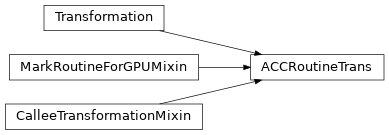
- class psyclone.transformations.ACCRoutineTrans[source]#
Transform a kernel or routine by adding a “!$acc routine” directive (causing it to be compiled for the OpenACC accelerator device). For example:
>>> from psyclone.tests.utilities import get_psylayer_schedule
>>> filename = "test11_different_iterates_over_one_invoke.f90"
>>> schedule = get_psylayer_schedule(filename, api="gocean")
>>>
>>> from psyclone.psyGen import CodedKern
>>> from psyclone.transformations import ACCRoutineTrans
>>> rtrans = ACCRoutineTrans()
>>> from psyclone.domain.common.transformations import (
...     KernelModuleInlineTrans)
>>> itrans = KernelModuleInlineTrans()
>>>
>>> kern = schedule.walk(CodedKern)[0]
>>> # Bring the kernel into the same module
>>> itrans.apply(kern)
>>> # Transform the kernel
>>> rtrans.apply(kern)
Inheritance
- apply(node, options=None, force=False, parallelism='seq', device_string='', **kwargs)[source]#
Add the ‘!$acc routine’ OpenACC directive into the code of the supplied Kernel (in a PSyKAl API such as GOcean or LFRic) or directly in the supplied Routine.
- Parameters:
node (
psyclone.psyGen.Kern|psyclone.psyir.nodes.Routine) – the kernel call or routine implementation to transform.options (Optional[Dict[str, Any]]) – a dictionary with options for transformations.
force (
bool) – whether to allow routines with CodeBlocks to run on the GPU.parallelism (
str) – the level of parallelism that the target routine (or a callee) exposes. One of “seq” (the default), “vector”, “worker” or “gang”.device_string (
str) – provide a compiler-platform identifier.
- validate(node, options=None, **kwargs)[source]#
Perform checks that the supplied kernel or routine can be transformed.
- Parameters:
node (
psyclone.psyGen.Kern|psyclone.psyir.nodes.Routine) – the kernel or routine which is the target of this transformation.options (Optional[Dict[str, Any]]) – a dictionary with options for transformations.
options["force"] (bool) – whether to allow routines with CodeBlocks to run on the GPU.
options["device_string"] (str) – provide a compiler-platform identifier.
force (bool) – whether to allow routines with CodeBlocks to run on the GPU.
parallelism (str) – the level of parallelism that the target routine (or a callee) exposes. One of “seq” (the default), “vector”, “worker” or “gang”.
device_string (str) – provide a compiler-platform identifier.
- Raises:
TransformationError – if the node is not a kernel or a routine.
TransformationError – if the target is a built-in kernel.
TransformationError – if it is a kernel but without an associated PSyIR.
TransformationError – if any of the symbols in the kernel are accessed via a module use statement.
TransformationError – if the kernel contains any calls to other routines.
TransformationError – if the ‘parallelism’ option is supplied but is not a recognised level of parallelism.
- class psyclone.transformations.ColourTrans[source]#
Apply a colouring transformation to a loop (in order to permit a subsequent parallelisation over colours). For example:
invoke = ...
schedule = invoke.schedule
ctrans = ColourTrans()
# Colour all of the loops
for child in schedule.children:
    ctrans.apply(child)
Inheritance

- apply(node, options=None, tiling=False, **kwargs)[source]#
Converts the Loop represented by
nodeinto a nested loop where the outer loop is over colours and the inner loop is over cells (or tiles and cells) of that colour.- Parameters:
node (
Loop) – the loop to transform.options (
Optional[Dict[str,Any]]) – options for the transformation.tiling (
bool) – whether to enable colour tiling.
- class psyclone.transformations.LFRicAsyncHaloExchangeTrans[source]#
Splits a synchronous halo exchange into a halo exchange start and halo exchange end.
Inheritance

- apply(node, options=None)[source]#
Transforms a synchronous halo exchange, represented by a HaloExchange node, into an asynchronous halo exchange, represented by HaloExchangeStart and HaloExchangeEnd nodes.
- Parameters:
node (
psyclone.psygen.HaloExchange) – a synchronous haloexchange node.options (Optional[Dict[str, Any]]) – a dictionary with options for transformations.
- property name#
- Returns:
the name of this transformation as a string.
- Return type:
str
- validate(node, options)[source]#
Internal method to check whether the node is valid for this transformation.
- Parameters:
node (
psyclone.psygen.HaloExchange) – a synchronous Halo Exchange nodeoptions (Optional[Dict[str, Any]]) – a dictionary with options for transformations.
- Raises:
TransformationError – if the node argument is not a HaloExchange (or subclass thereof)
- class psyclone.transformations.LFRicColourTrans[source]#
Split an LFRic loop over cells into colours so that it can be parallelised. For example:
>>> from psyclone.tests.utilities import get_psylayer_schedule
>>> filename = "4.6_multikernel_invokes.f90"
>>> schedule = get_psylayer_schedule(filename, api="lfric")
>>>
>>> from psyclone.psyir.nodes import Loop
>>> from psyclone.transformations import (
...     LFRicColourTrans, LFRicOMPParallelLoopTrans)
>>>
>>> ctrans = LFRicColourTrans()
>>> otrans = LFRicOMPParallelLoopTrans()
>>>
>>> # Colour all of the loops
>>> for child in schedule.walk(Loop, stop_type=Loop):
...     ctrans.apply(child)
>>>
>>> # Then apply OpenMP to each of the colour loops
>>> for child in schedule.walk(Loop, stop_type=Loop):
...     otrans.apply(child.loop_body[0])
Colouring in the LFRic API is subject to the following rules:
Only kernels which operate on ‘CELL_COLUMN’s and which increment a field on a continuous function space require colouring. Kernels that update a field on a discontinuous function space will cause this transformation to raise an exception. Kernels that only write to a field on a continuous function space also do not require colouring but are permitted.
A kernel may have at most one field with ‘GH_INC’ access.
A separate colour map will be required for each field that is coloured (if an invoke contains >1 kernel call).
Inheritance

- apply(node, options=None, **kwargs)[source]#
Convert the given LFRic-specific loop into a double or triple nested loop where the outer loop iterates over colours and the inner loops iterates over cells or tile and cells. This enables safe parallelisation of the second loop.
- Parameters:
node (
LFRicLoop) – the loop to transform.options (
Optional[Dict[str,Any]]) – a dictionary with options for transformations.tiling (bool) – whether to enable colour tiling.
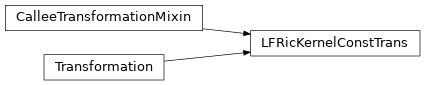
- class psyclone.transformations.LFRicKernelConstTrans[source]#
Modifies a kernel so that the number of dofs, number of layers and number of quadrature points are fixed in the kernel rather than being passed in by argument.
from psyclone.transformations import LFRicKernelConstTrans
trans = LFRicKernelConstTrans()
for kernel in schedule.coded_kernels():
    trans.apply(kernel, number_of_layers=150)
    kernel_schedule = kernel.get_callees()[0]
Inheritance
- apply(node, options=None)[source]#
Transforms a kernel so that the values for the number of degrees of freedom (if valid values for the element_order_h and element_order_v args are provided), the number of quadrature points (if the quadrature arg is set to True) and the number of layers (if a valid value for the number_of_layers arg is provided) are constant in a kernel rather than being passed in by argument.
The “cellshape”, “element_order_h”, “element_order_v” and “number_of_layers” arguments are provided to mirror the namelist values that are input into an LFRic model when it is run.
Quadrature support is currently limited to XYoZ in this transformation. In the case of XYoZ the number of quadrature points in the horizontal are set to element_order_h+3, and in the vertical to element_order_v+3. These values are set in the LFRic infrastructure, so their value is derived.
- Parameters:
node (
psyclone.domain.lfric.LFRicKern) – a kernel node.options (Optional[Dict[str, Any]]) – a dictionary with options for transformations.
options["cellshape"] (str) – the shape of the cells. This is provided as it helps determine the number of dofs a field has for a particular function space. Currently only “quadrilateral” is supported which is also the default value.
options["element_order_h"] (int) – the polynomial order of the cell in the horizontal. In combination with cellshape and element_order_v, this determines the number of dofs a field has for a particular function space. If it is set to None (the default), then the dofs values are not set as constants in the kernel, otherwise they are.
options["element_order_v"] (int) – the polynomial order of the cell in the vertical. In combination with cellshape and element_order_h, this determines the number of dofs a field has for a particular function space. If it is set to None (the default), then the dofs values are not set as constants in the kernel, otherwise they are.
options["number_of_layers"] (int) – the number of vertical layers in the LFRic model mesh used for this particular run. If this is set to None (the default) then the nlayers value is not set as a constant in the kernel, otherwise it is.
options["quadrature"] (bool) – whether the number of quadrature points values are set as constants in the kernel (True) or not (False). The default is False.
- property name#
- Returns:
the name of this transformation as a string.
- Return type:
str
- validate(node, options=None)[source]#
This method checks whether the input arguments are valid for this transformation.
- Parameters:
node (
psyclone.domain.lfric.LFRicKern) – an LFRic kernel node.options (Optional[Dict[str, Any]]) – a dictionary with options for transformations.
options["cellshape"] (str) – the shape of the elements/cells.
options["element_order_h"] (int) – the horizontal order of the elements/cells.
options["element_order_v"] (int) – the vertical order of the elements/cells.
options["number_of_layers"] (int) – the number of layers to use.
options["quadrature"] (bool) – whether quadrature dimension sizes should or shouldn’t be set as constants in a kernel.
- Raises:
TransformationError – if the node argument is not a lFRic kernel, the cellshape argument is not set to “quadrilateral”, the element_order_h or element_order_v arguments are not a 0 or a positive integer, the number of layers argument is not a positive integer, the quadrature argument is not a boolean, neither element orders nor number of layers arguments are set (as the transformation would then do nothing), or the quadrature argument is True but the element order is not provided (as the former needs the latter).
- class psyclone.transformations.LFRicOMPLoopTrans(omp_schedule='static')[source]#
LFRic specific orphan OpenMP loop transformation. Adds LFRic-specific validity checks.
- Parameters:
omp_schedule (str) – the OpenMP schedule to use. Must be one of ‘runtime’, ‘static’, ‘dynamic’, ‘guided’ or ‘auto’. Defaults to ‘static’.
Inheritance

- apply(node, options=None, **kwargs)[source]#
Apply LFRic specific OMPLoopTrans.
- Parameters:
node (
psyclone.psyir.nodes.Node) – the Node in the Schedule to check.options (Optional[dict[str, Any]]) – a dictionary with options for transformations and validation.
options["reprod"] (bool) – indicating whether reproducible reductions should be used. By default the value from the config file will be used.
- validate(node, options=None, **kwargs)[source]#
Perform LFRic specific loop validity checks for the OMPLoopTrans.
- Parameters:
node (
psyclone.psyir.nodes.Node) – the Node in the Schedule to checkoptions (Optional[Dict[str, Any]]) – a dictionary with options for transformations and validation.
options["reprod"] (bool) – indicating whether reproducible reductions should be used. By default the value from the config file will be used.
- Raises:
TransformationError – if an OMP loop transform would create incorrect code.
- class psyclone.transformations.LFRicOMPParallelLoopTrans(omp_directive='do', omp_schedule='static')[source]#
LFRic-specific OpenMP loop transformation. Adds LFRic specific validity checks. Actual transformation is done by the
base class.- Parameters:
omp_directive (str) – choose which OpenMP loop directive to use. Defaults to “do”.
omp_schedule (str) – the OpenMP schedule to use. Must be one of ‘runtime’, ‘static’, ‘dynamic’, ‘guided’ or ‘auto’. Defaults to ‘static’.
Inheritance

- apply(node, options=None, **kwargs)[source]#
Add OpenMP Parallel for LFRic PSy-layer loops.
- Parameters:
node (
psyclone.psyir.nodes.Loop) – the given loop node.options (Optional[Dict[str, Any]]) – a dictionary with options for transformations and validation.
force_private (Iterable[str]) – specify a list of symbol names explicitly requested to be private.
- validate(node, options=None, **kwargs)[source]#
Perform LFRic-specific loop validity checks then call the validate method of the base class.
- Parameters:
node (
psyclone.psyir.nodes.Node) – the Node in the Schedule to checkoptions (Optional[Dict[str, Any]]) – a dictionary with options for transformations.
force_private (Iterable[str]) – specify a list of symbol names explicitly requested to be private.
- Raises:
TransformationError – if the supplied Node is not an LFRicLoop.
TransformationError – if the associated loop requires colouring.
- class psyclone.transformations.GOceanOMPLoopTrans(omp_directive='do', omp_schedule='static')[source]#
GOcean-specific orphan OpenMP loop transformation. Adds GOcean specific validity checks (that the node is either an inner or outer Loop).
- Parameters:
omp_directive (str) – choose which OpenMP loop directive to use. Defaults to “do”.
omp_schedule (str) – the OpenMP schedule to use. Must be one of ‘runtime’, ‘static’, ‘dynamic’, ‘guided’ or ‘auto’. Defaults to ‘static’.
Inheritance

- validate(node, options=None, **kwargs)[source]#
Checks that the supplied node is a valid target for parallelisation using OMP directives.
- Parameters:
node (
psyclone.psyir.nodes.Loop) – the candidate loop for parallelising using OMP Do.options (Optional[Dict[str, Any]]) – a dictionary with options for transformations.
- Raises:
TransformationError – if the loop_type of the supplied Loop is not “inner” or “outer”.
- class psyclone.transformations.GOceanOMPParallelLoopTrans(omp_directive='do', omp_schedule='static')[source]#
GOcean specific OpenMP Do loop transformation. Adds GOcean specific validity checks (that supplied Loop is an inner or outer loop). Actual transformation is done by
base class.- param str omp_directive:
choose which OpenMP loop directive to use. Defaults to “do”.
- param str omp_schedule:
the OpenMP schedule to use. Must be one of ‘runtime’, ‘static’, ‘dynamic’, ‘guided’ or ‘auto’. Defaults to ‘static’.
Inheritance

- apply(node, options=None)[source]#
Perform GOcean-specific loop validity checks then call
OMPParallelLoopTrans.apply().- Parameters:
node (
psyclone.psyir.nodes.Loop) – a Loop node from an AST.options (Optional[Dict[str, Any]]) – a dictionary with options for transformations and validation.
- Raises:
TransformationError – if the supplied node is not an inner or outer loop.
- class psyclone.transformations.KernelImportsToArguments[source]#
Transformation that removes any accesses of imported data from the supplied kernel and places them in the caller. The values/references are then passed by argument into the kernel.
Inheritance

- apply(node, options=None)[source]#
Convert the imported variables used inside the kernel into arguments and modify the InvokeSchedule to pass the same imported variables to the kernel call. Since it is a pre-requisite that the kernel have been module-inlined first, this transformation must also update all other calls to the same module-inlined routine.
- Parameters:
node (
psyclone.psyGen.CodedKern) – a kernel call.options (Optional[Dict[str, Any]]) – a dictionary with options for transformations.
- property name#
- Returns:
the name of this transformation.
- Return type:
str
- validate(node, options=None)[source]#
Check that the supplied node is a valid target for this transformation.
- Parameters:
node (
psyclone.psyGen.CodedKern) – the PSyIR node to validate.options (Optional[Dict[str, Any]]) – a dictionary with options for transformations.
- Raises:
TransformationError – if the supplied node is not a CodedKern.
TransformationError – if this transformation is not applied to a Gocean API Invoke.
TransformationError – if the supplied node is a polymorphic Kernel.
TransformationError – if the supplied kernel contains wildcard imports of symbols from one or more containers (e.g. a USE without an ONLY clause in Fortran).
- class psyclone.transformations.OMPMasterTrans[source]#
Create an OpenMP MASTER region by inserting directives. The most likely use case for this transformation is to wrap around task-based transformations. Note that adding this directive requires a parent OpenMP parallel region (which can be inserted by OMPParallelTrans), otherwise it will produce an error in generation-time.
For example:
>>> from psyclone.tests.utilities import get_psylayer_schedule
>>> filename = "test11_different_iterates_over_one_invoke.f90"
>>> schedule = get_psylayer_schedule(filename, api="gocean")
>>>
>>> from psyclone.transformations import OMPMasterTrans
>>> from psyclone.psyir.transformations import OMPParallelTrans
>>> mastertrans = OMPMasterTrans()
>>> paralleltrans = OMPParallelTrans()
>>>
>>> # Enclose all of these loops within a single OpenMP
>>> # MASTER region
>>> mastertrans.apply(schedule.children)
>>> # Enclose all of these loops within a single OpenMP
>>> # PARALLEL region
>>> paralleltrans.apply(schedule.children)
Inheritance

- property name#
- Returns:
the name of this transformation as a string.
- Return type:
str
- class psyclone.transformations.OMPSingleTrans(nowait=False)[source]#
Create an OpenMP SINGLE region by inserting directives. The most likely use case for this transformation is to wrap around task-based transformations. The parent region for this should usually also be a OMPParallelTrans.
- Parameters:
nowait (bool) – whether to apply a nowait clause to this transformation. The default value is False
For example:
>>> from psyclone.tests.utilities import get_psylayer_schedule
>>> filename = "test11_different_iterates_over_one_invoke.f90"
>>> schedule = get_psylayer_schedule(filename, api="gocean")
>>>
>>> from psyclone.transformations import OMPSingleTrans
>>> from psyclone.psyir.transformations import OMPParallelTrans
>>> singletrans = OMPSingleTrans()
>>> paralleltrans = OMPParallelTrans()
>>>
>>> # Enclose all of these loops within a single OpenMP
>>> # SINGLE region
>>> singletrans.apply(schedule.children)
>>> # Enclose all of these loops within a single OpenMP
>>> # PARALLEL region
>>> paralleltrans.apply(schedule.children)
>>> # Uncomment the following line to see a text view of the schedule
>>> # print(schedule.view())
Inheritance

- apply(node_list, options=None)[source]#
Apply the OMPSingleTrans transformation to the specified node in a Schedule.
At code-generation time (when lowering is called) this node must be within (i.e. a child of) an OpenMP PARALLEL region.
If the keyword “nowait” is specified in the options, it will cause a nowait clause to be added if it is set to True, otherwise no clause will be added.
- Parameters:
node_list ((a list of)
psyclone.psyir.nodes.Node) – the supplied node or node list to which we will apply the OMPSingleTrans transformationoptions (Optional[Dict[str, Any]]) – a list with options for transformations and validation.
options["nowait"] (bool) – indicating whether or not to use a nowait clause on this single region.
- property name#
- Returns:
the name of this transformation.
- Return type:
str
- property omp_nowait#
- Returns:
whether or not this Single region uses a nowait clause to remove the end barrier.
- Return type:
bool